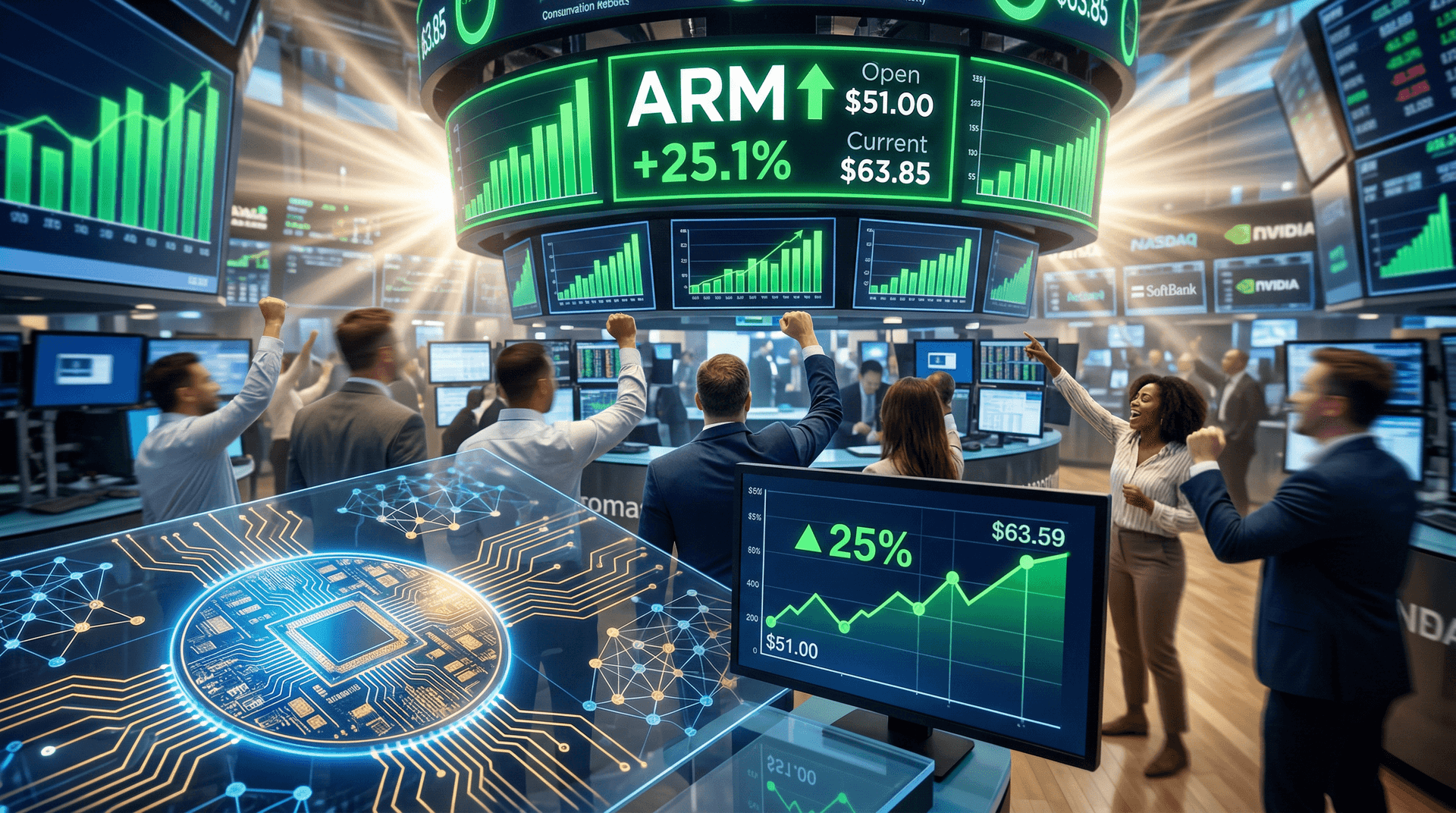
In a resounding vote of confidence for the semiconductor industry, Arm Holdings plc (ARM) stormed onto the Nasdaq on September 14, 2023, delivering one of the most successful tech IPOs in recent memory. Shares priced at $51 apiece opened at $56.10 and rocketed to an intraday high of $68.64 before closing at $63.59—a 24.7% gain on the first day. This performance valued the Cambridge, UK-based company at approximately $65 billion, marking a pivotal moment for the chip design powerhouse amid surging demand for AI technologies.
A Storied Path to Public Markets
Arm's journey to this IPO has been anything but conventional. Founded in 1990 as part of Acorn Computers, the firm pioneered energy-efficient processor architectures that power nearly every smartphone on the planet. Today, Arm's designs are licensed to giants like Apple, Qualcomm, Samsung, and Nvidia, forming the backbone of mobile computing.
In 2016, Japan's SoftBank Group acquired Arm for $32 billion in a deal that stunned the tech world. Under SoftBank CEO Masayoshi Son's vision, Arm pivoted toward data centers, automotive, and now AI applications. The IPO, long anticipated and delayed by market volatility and regulatory hurdles, was finally greenlit despite a tepid IPO environment in 2023. Only 95.3 million shares were offered—about 9.5% of the company—mostly by SoftBank, which retains a 90% stake post-IPO.
The offering raised $4.87 billion, making it the largest U.S. tech IPO since Rivian in 2021. Underwriters, led by Goldman Sachs, exercised a greenshoe option to sell additional shares, potentially boosting proceeds further.
Riding the AI Wave
Timing couldn't have been better. Arm's resurgence coincides with the generative AI explosion triggered by OpenAI's ChatGPT late last year. While Arm has historically dominated mobile chips, its scalable architectures are increasingly vital for AI accelerators and edge computing.
Nvidia CEO Jensen Huang has publicly praised Arm, noting its designs underpin some of the world's most efficient AI systems. Apple's M-series chips, based on Arm, power MacBooks and iPads with unmatched battery life. Meanwhile, hyperscalers like Amazon (via AWS Graviton) and Google are adopting Arm for cloud servers to cut costs.
In its latest fiscal year ending March 31, 2023, Arm reported revenue of $2.68 billion, up 14% year-over-year, with royalties surging 28% thanks to higher-end chip shipments. Licensing revenue dipped slightly due to market softness, but v9 architecture royalties—optimized for AI—jumped 17%. CEO Rene Haas, who took the helm in 2022, emphasized during the IPO roadshow that Arm is "at the epicenter of the AI revolution."
Market Reaction and Broader Implications
Wall Street's enthusiasm was palpable. The stock's debut outperformed even bullish analyst targets; Goldman Sachs pegged it at $58. Trading volume exceeded 73 million shares, reflecting intense investor interest. By September 29, shares hovered around $62, still up 22% from the IPO price, amid broader market gains.
This IPO signals a thaw in the IPO freezer burned by 2022's bear market. Peers like Intel and AMD have struggled with PC slumps, but Arm's royalty model—earning perpetual fees per chip shipped—provides resilience. It doesn't manufacture silicon, avoiding capex burdens that plague foundries like TSMC.
Critics note risks: Heavy reliance on smartphones (45% of royalties) exposes Arm to consumer slowdowns. Geopolitical tensions, including U.S.-China chip wars, could disrupt China-derived revenue (25%). SoftBank's control also raises governance flags, with some investors wary of Son's aggressive style.
Yet, bulls dominate. Arm projects 20%+ revenue growth this fiscal year, driven by AI PCs, automotive electrification, and IoT. Partnerships with Microsoft for Azure Arm instances and Qualcomm's PC push bolster the thesis.
What It Means for Investors and Tech
For retail investors locked out of the IPO allocation, secondary market access via platforms like Robinhood opened doors. Institutions poured in, with BlackRock and Vanguard among early buyers.
The debut underscores semiconductors' centrality to the "Magnificent Seven" rally. Nvidia's 200%+ YTD surge has lifted the sector; Arm joins as a pure-play designer, potentially rivaling ASML in valuation multiples.
Looking ahead, Arm eyes expansion into Windows on Arm via Qualcomm's Snapdragon X Elite, challenging Intel's x86 dominance. Success here could unlock billions in new royalties.
As Haas stated in a Bloomberg interview post-IPO: "We're just getting started. The v9 architecture is barely penetrated, and AI is a multi-decade opportunity."
Navigating Choppy Waters
Challenges loom. The U.S. Federal Reserve's September 20 decision to hold rates steady at 5.25-5.50% provided relief, but inflation data could prompt hikes, pressuring growth stocks. Supply chain snarls from Taiwan tensions add uncertainty.
Still, Arm's moat—ubiquitous IP licensed to 1,000+ partners—is formidable. With 99% of smartphones and growing server share, it's positioned for the compute-intensive AI era.
In summary, Arm's IPO isn't just a financial win; it's a bellwether for tech's next chapter. As smartphones mature, Arm's pivot to AI and beyond cements its role as the "architect of intelligence." Investors watching Nvidia's Grace CPU or Apple's custom silicon know: Arm is everywhere, and now publicly traded.
Word count: 912