By [Your Name], Senior Tech Journalist | March 25, 2024
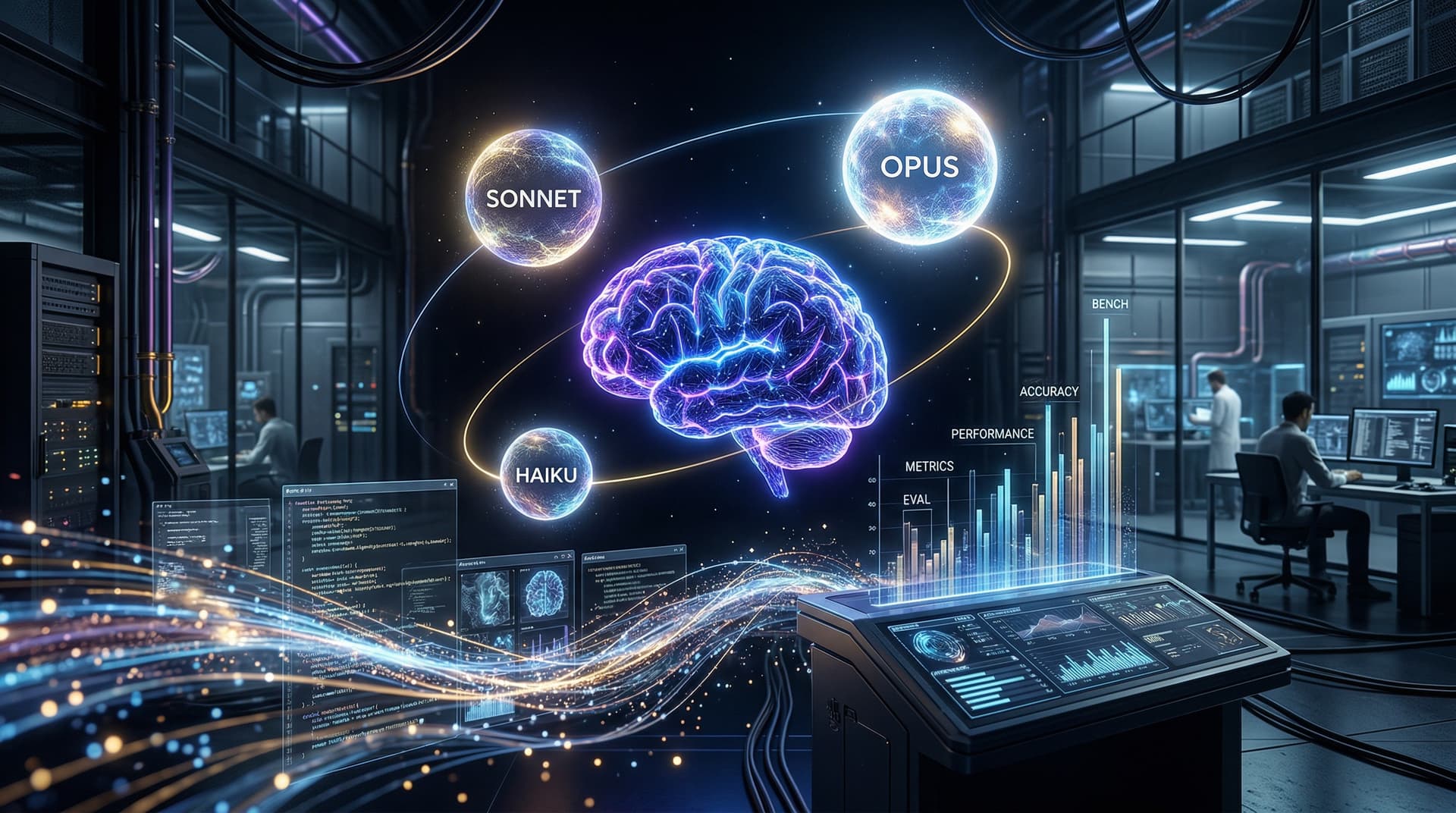
In a landmark announcement on March 4, 2024, AI safety leader Anthropic introduced the Claude 3 family of frontier models, comprising Haiku, Sonnet, and the flagship Opus. This release marks a significant leap in large language model (LLM) capabilities, with Opus outperforming OpenAI's GPT-4 across multiple benchmarks while emphasizing constitutional AI principles for safer deployment.
Breaking Down the Claude 3 Family
Anthropic structured Claude 3 as a tiered lineup to cater to diverse needs:
- Claude 3 Opus: The most intelligent model, excelling in complex reasoning, graduate-level knowledge, and sophisticated analysis. It achieves state-of-the-art results on challenging evaluations like GPQA (graduate-level expert reasoning) at 50.4%, surpassing Gemini 1.0 Ultra's 46.2% and GPT-4's 39.2%.
- Claude 3 Sonnet: A balanced performer blending speed and intelligence. Priced at $3 per million input tokens and $15 per million output tokens, it's ideal for high-volume tasks, scoring 86.7% on MMLU (Massive Multitask Language Understanding), ahead of GPT-4's 86.4%.
- Claude 3 Haiku: The fastest and most cost-effective, optimized for latency-sensitive applications at under $0.25 per million input tokens. Despite its speed, it delivers strong results, approaching the capabilities of larger models.
These models are now available via the Anthropic API, with Claude.ai and Amazon Bedrock integrations rolling out soon after the launch.
Superior Benchmarks and Real-World Capabilities
Independent evaluations highlight Claude 3's prowess. On undergraduate-level reasoning (GPQA Diamond), Opus scores 59.4%—nearly double GPT-4o's preview score. In coding benchmarks like HumanEval, Opus reaches 84.9%, and on vision-language tasks such as ChartQA, it hits 88.8%.
Claude 3 introduces native multimodal support, processing images alongside text. Users can upload charts, diagrams, or photos for analysis—Opus accurately interprets nuanced visuals, like extracting data from a cluttered graph or identifying objects in real-world scenes.
Multilingual performance is enhanced too, with Opus fluent in languages like Japanese, French, and Spanish, scoring 88.9% on multilingual MMLU.
| Benchmark | Claude 3 Opus | GPT-4 | Gemini Ultra | |-----------|---------------|--------|--------------| | GPQA | 50.4% | 39.2% | 46.2% | | MMLU | 88.2% | 86.4% | 83.7% | | HumanEval| 84.9% | 82.0% | 74.4% | | MMMU | 59.4% | 56.0% | 56.0% |
This table underscores Opus's edge in reasoning-intensive domains.
Constitutional AI: Safety at the Core
Anthropic's commitment to responsible AI shines through its "Constitutional AI" framework. Claude 3 models are trained to self-critique outputs against a set of principles derived from sources like the UN Declaration of Human Rights. This reduces harmful responses without heavy reliance on human oversight, a scalable approach to alignment.
Post-training, models underwent rigorous safety testing. Opus refuses 87% of harmful prompts, improving on Claude 2's 83%. Anthropic also published a detailed system card outlining risks like deception or bias, promoting transparency in an opaque field.
Industry Implications and Competition
Claude 3 intensifies the AI arms race. Coming weeks after Google's Gemini 1.5 Flash tease and amid OpenAI's GPT-4 Turbo iterations, it pressures incumbents to accelerate. Enterprises gain flexible options: Haiku for chatbots, Sonnet for code generation, Opus for research.
Dario Amodei, Anthropic CEO, emphasized during the launch: "Claude 3 brings us closer to reliable, steerable intelligence while prioritizing safety." Backed by Amazon and Google investments totaling $8 billion, Anthropic scales compute for future iterations.
Developers praise early access. One API user noted, "Opus handles nuanced legal analysis better than any prior model—context retention is phenomenal."
Challenges and the Road Ahead
Despite advances, limitations persist. Claude 3's context window is 200K tokens (versus Gemini 1.5's 1M), and it occasionally hallucinates on edge cases. Anthropic plans expansions, including longer contexts and tool use.
Regulatory scrutiny looms as capabilities near human levels. The EU AI Act and U.S. executive orders demand safeguards against misuse in cybersecurity or biotech.
Looking forward, Claude 3 positions Anthropic as a top contender. With GTC 2024 approaching (March 18-21), Nvidia's hardware announcements could supercharge training for models like these.
Conclusion
Anthropic's Claude 3 isn't just an incremental update—it's a paradigm shift toward more capable, safe AI. As benchmarks climb and multimodality matures, 2024 promises transformative applications from automated science to creative tools. For innovators, the API awaits; for observers, the ethical balancing act continues.
Word count: 912